

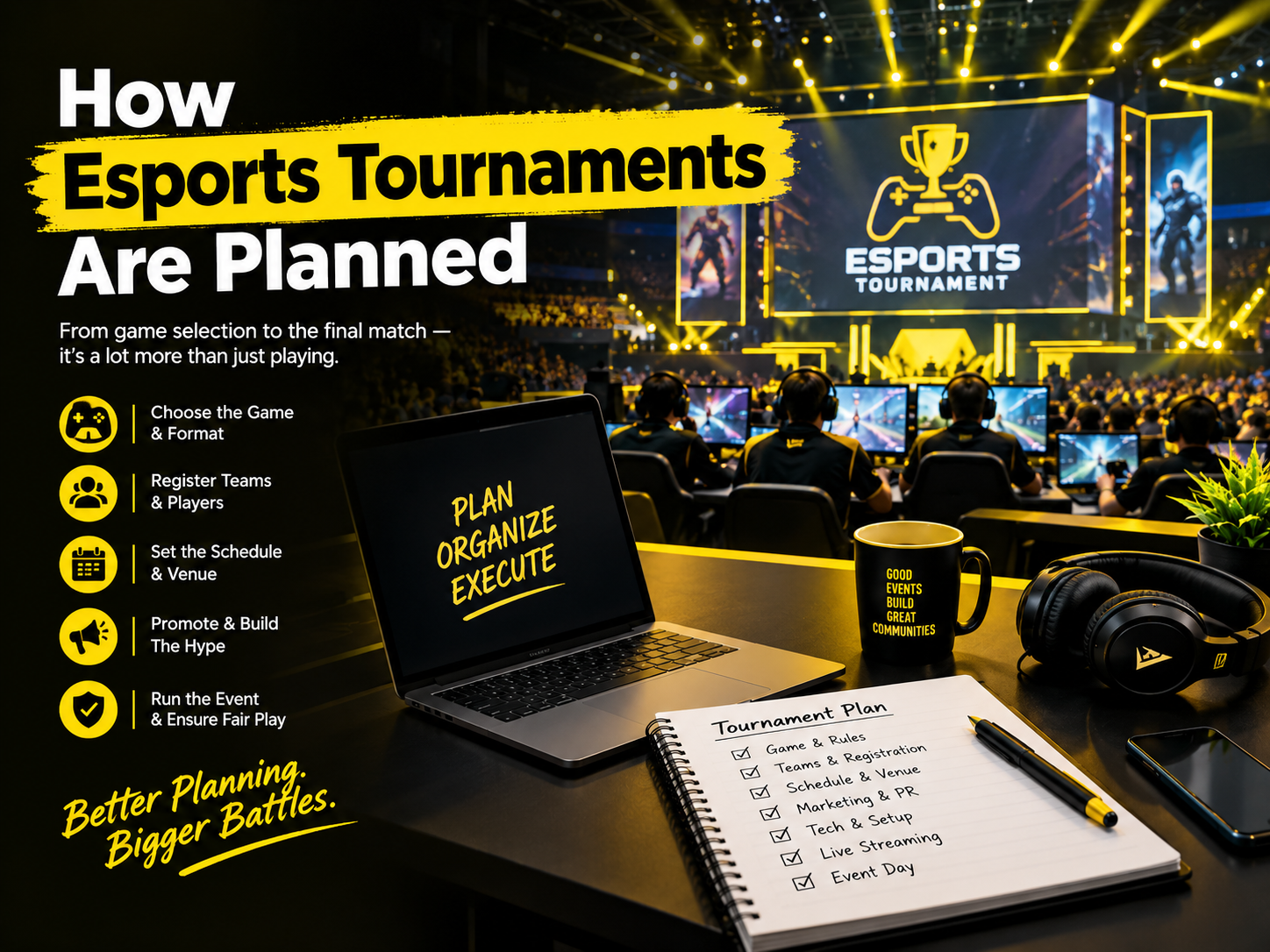
How Esports Tournaments Work
Esports Tournaments Have Grown From Simple Gaming Competitions to Grand Scale Glasses Esports Tournaments, or competitive gaming, People used to think they were only for kids. But Over the past 10 years, they have grown from humble video game battles between friends to major global sporting events watched by thousands, even millions, of people around the world.
But, how do esports tournaments work?
A successful esports tournament needs much more than Good players. Organizers need to pick a game, create rules, register players and teams, make a plan, manage matches, solve technical issues, and make sure the competition is fair. Referees, TV or online presenters, sponsors, Event teams, and other staff also have important roles.
In this guide, we will look at how esports tournaments are planned and run, from the first step to the final match.
What Is an Esports Tournament?
An esports tournament is a video game competition. Players or teams compete against each other to win.
It is more serious than casual gaming, esports competitions follow a planned structure. Players usually have to register for the event, Follow the game rules, and Play planned matches. Their results Check if they move Next in the competition.
Popular esports games include:
- The popular CS2 shooter game
- Dota 2
- League of Legends
- VALORANT
- Overwatch
- Rocket League
- Rainbow Six Siege
- PUBG and other competitive games
Some tournaments are small local events, Some events are simple, while others have professional teams, big sponsors, and players from different countries, live audiences, and large prize pools.
Choosing the Game and Tournament Type
The first step in an esports tournament organization is deciding what game the event will use.
Organizers may choose a game based on its competitive scene, player interest, audience size, available tournament systems, and technical requirements.
They also need to decide what type of tournament they want to run.
Single-Game vs Multi-Game Events
A single-game tournament focuses on one title. For example, an event may be created only for CS2 or VALORANT.
A multi-game event is made up of different games. You need to plan more because each game may follow different rules, Tools, schedules, and Competition types.
Online vs Offline Tournaments
Online tournaments allow players to compete from different locations. They are usually easier to organize and can attract players from different regions.
Offline tournaments take place at a physical venue. Teams travel to the event and compete using equipment prepared by the organizers.
Amateur vs Professional Events
Amateur tournaments are usually open to less experienced players and community teams.
Professional competitions often include established esports teams and players. They may also have qualifiers, invited teams, strict rules, media coverage, sponsors, and professional production.
Regional vs International Tournaments
A regional esports competition may be limited to players from a specific country or area.
World competitions Take groups from different countries together. These events need extra planning for travel, time zones, places to stay, visas, and communication.
How Players and Teams Register
After choosing the tournament type, Organizers need to register players and teams.
Registration helps organizers with important information about the people taking part in the event.
The process may include:
- Player or team name
- Player information
- Contact details
- Team members
- Game account information
- Country or region
- Age or eligibility information
- Registration fee, if applicable
Organizers usually set a registration deadline. They may also check player information before accepting a team.
Some big competitions do not allow everyone to join directly. Instead, teams can qualify through smaller tournaments. or receive invitations based on their previous performance.
How Esports Tournament Formats Work
The esports tournament Type Shows how teams or Players move to the next stage.
Different types are used Based on the number of participants, Free time, game type, and tournament goals.
Single Elimination
In a tournament where the loser leaves. If a team loses one game. They leave the tournament.
For example, If 16 teams join the tournament, The competition can continue:
- Round of 16
- Quarterfinals
- Semifinals
- Final
This format is simple and can be completed relatively quickly.
Double Elimination
A two-loss knockout tournament gives teams another chance after their first loss.
There are two brackets, one for winners and one for teams that lose. A team that loses in the winners bracket can move to the losers bracket in place of Right away leaving the tournament.
A second loss usually eliminates the team.
This type can provide more matches and give teams a chance to recover after an early loss.
Round Robin
In a round-robin format, teams play against several or all other teams in their group.
Teams receive points or records based on their results. These results are then used to create rankings.
So, a tournament may use a group stage where teams play multiple matches before the top teams move into the playoffs.
Swiss Format
The Swiss type allows teams to play opponents with similar results.
Teams are not required to play every other team. In place of, Games change based on previous results.
This type can handle a large number of participants while giving teams many matches.
Making the Esports Tournament Schedule
A clear esports tournament schedule helps everyone understand when matches will take place.
Organizers need to decide:
- Match dates
- Match times
- Match order
- Group-stage schedules
- Playoff schedules
- Break times
- Practice periods
- Opening and closing events
- Broadcast times
Time zones matter a lot in international competitions. The match may start at 7:00 PM in Bangladesh.
The time will be different in Europe. It will also be different in North America. So, organizers should clearly share the match time.
Schedules also need some flexibility. Technical problems, long matches, player delays, or other unexpected issues can affect the original plan.
Setting Tournament Rules
Clear esports tournament rules are important for fair competition.
Rules explain what players and teams can and cannot do during the event.
Tournament rules may cover:
- Player eligibility
- Team requirements
- Match settings
- Game settings
- Allowed equipment
- Communication rules
- Player behavior
- Cheating
- Exploits
- Disconnections
- Technical problems
- Match delays
- Protests and disputes
- Penalties
- Disqualification
Give clear rules to players before the competition starts. This helps avoid confusion in matches.
For example, if a player stops working because of an internet problem, the rules should explain what happens next. The same is true to server problems, game crashes, or other technical issues.
What Referees and Tournament Officials Do
People in charge of the tournament help keep the Competition held and fair.
Game officials or Managers may watch and check games and make sure teams follow the rules.
Their duties can add:
- Starting and stopping matches
- Checking player eligibility
- Monitoring rule violations
- Handling disputes
- Reviewing incidents
- Managing technical problems
- Confirming match results
- Applying penalties when necessary
In larger competitions, several officials may work together.
Having clear officials and procedures is important because esports matches can move quickly. A small technical or rule-related issue can affect the result of a match.
How Esports Matches Are Managed
At the start of the game, the organizers need to prepare everything.
This may include checking:
- Players and team lineups
- Game accounts
- Servers
- Computers or consoles
- Internet connections
- Game settings
- Voice communication
- Match settings
When everything is ready, the match can start.
In the match, officials may monitor the game and watch for technical or How to Solve Problems.
After the game is over, the result is recorded. The result can then be used to update group standings, brackets, or playoff positions.
In Work events, match information may also be sent to the production team for live broadcasts and statistics.
How Esports Tournaments Handle Prizes
Prize pools are an important part of many esports tournaments.
The prize pool is the total amount or value that organizers plan to distribute to successful players or teams.
Prizes can include:
- Cash rewards
- Trophies
- Medals
- Gaming equipment
- Sponsor products
- Other awards
The prize distribution should be explained before the tournament begins.
So, The organizers may decide that the winner gets part of the prize money, The second- and third-place teams get less money.
Some events also provide special awards for individual players or teams.
The Role of Sponsors and Partners
Supporters can play an important role in esports Event planning.
Big tournaments can be costly because organizers may need to pay for the place, equipment, staff, Showing live, travel support, marketing, and other services.
Supporters can provide money help or products and services.
A sponsor might provide:
- Gaming equipment
- Computers
- Headsets
- Internet services
- Venue support
- Advertising support
- Cash sponsorship
As a result, sponsors may receive chances to promote your business in the event.
Their logos can show on team jerseys, tournament websites, TV graphics, event stages, and Ads and marketing.
How Esports Tournaments Are Broadcast
Modern esports tournaments are often designed for both players and viewers.
Live broadcasts allow people to watch matches even when they are not at the event venue.
A professional esports broadcast may include:
- Live gameplay
- Commentators
- Analysts
- Game observers
- Replay operators
- Graphics
- Player statistics
- Team information
- Match scores
- Interviews
Game speakers explain what is happening in the match, while Experts may discuss Game plans and player performance.
Production teams also handle the cameras, audio, graphics, replays, and other broadcast parts.
Streaming services make it possible for esports fans around the world to follow live tournaments from their computers or mobile devices.
Online vs Offline Esports Tournaments
| Online Tournament | Offline Tournament |
| Players compete remotely | Players meet at a physical venue |
| Usually lower venue costs | Higher venue and production costs |
| Easier international participation | Creates a live audience experience |
| Internet quality is very important | Venue equipment is very important |
| Players use their own setups in many events | Organizers often provide equipment |
| Easier to run smaller events | Better for big live events |
Online and offline tournaments both have advantages and challenges.The best choice depends on the size and goal of the competition.
A small tournament with a few teams can work well online, A big esports championship can take place in a large arena or special esports venue.
How Organizers Handle Technical Problems
Technical problems can affect an esports tournament in many ways.
Even if everything is well prepared, unexpected problems may happen.
Common issues include:
- Internet connection problems
- Server failures
- Computer problems
- Hardware failures
- Player disconnections
- Game crashes
- Audio problems
- Power failures
- Streaming problems
Organizers should have backup plans for these situations.
For example, they may keep backup computers, extra network equipment, technical staff, alternative servers, and backup communication systems ready.
Rules should cover technical problems. They should explain match problems.
It depends. The game may be paused for a while, Start that part again, or make another move according to the rules.
What Happens After the Tournament?
The work does not end when the final match is over.
Organizers still need to complete several tasks.
They may need to:
- Confirm the final results.
- Update tournament standings.
- Distribute prizes.
- Complete player or team rankings.
- Publish match results.
- Share photos and highlights.
- Review the event.
- Collect feedback.
- Check technical and production performance.
- Start planning future events.
After the event, organizers can review it.They can see what went well. They can find what needs to improve.
For example, they may review audience numbers, broadcast performance, match delays, player feedback, and technical issues.
Why Good Organization Matters in Esports
Good planning is important for esports tournaments. People and systems work together. Players need fair play and easy rules.
Players need fair competition and clear rules.
Teams need reliable schedules and communication.
Referees need clear procedures for handling problems.
Viewers need a smooth broadcast and accurate information.
Sponsors want well-organized events and clear ways to build your brand.
When these parts work together, the tournament can make the experience better for everyone.
Poor planning, in another case, can cause timing problems, arguments, technical problems, rules that are not clear, or viewers may not enjoy it.
This is why esports events need careful planning from the start, when, and after the competition.
Final Thoughts
So, how esports tournaments are organized is a process using much more than adding players to the game and Picking a winner.
First, organizers choose the game and tournament type. Then, they sign up the players, make the tournament type, make schedules, make rules, choose officials, plan matches, give out prizes, have sponsors, and set up live broadcasts.
They also need Extra copy plans for technical problems and Unexpected delays.
A small online competition or a big global esports event, successful events depend on good planning and teamwork.
The Teamwork of clear rules, The right tournament type, Trusted technology, Fair refereeing, good scheduling, and good event management makes gaming competitions better. It gives players and viewers a better experience.
Frequently Asked Questions About Esports Tournaments
1. How are esports tournaments organized?
The main steps are choosing a game and teams. Then, organizers set rules and run matches. Finally, they give prizes.
2 .What are the most common esports tournament formats?
Common types are single elimination, Two chances to lose, Every team plays against all the other teams, and Swiss. Some tournaments use a mix of these types.
3.How do players qualify for esports tournaments?
Players can join through registration or qualifiers. Some are invited or ranked. The process depends on the tournament.
4.How long does an esports tournament last?
The time can be different. A small online tournament can finish in one day, A main esports tournament can last many days or weeks.
5.Who manages esports tournament rules?
Organizers make the rules. They enforce the rules. Referees handle rule violations. They also solve match disputes.
6.How are esports tournament winners decided?
Winners are decided by match results. Teams move through different rounds. The final match decides the winner. The winner becomes the champion.
7.How do esports tournaments make money?
Esports tournaments make money in different ways. They can earn money from sponsors and ads.
8.Online vs. Offline Esports Tournaments
Online tournaments happen remotely. Offline tournaments happen at a venue. Online events need good internet access. Offline events need staff and equipment.